


Cross-border 2026 - why is bid translation not enough?
Selling abroad in e-commerce was until recently mainly associated with translating listings and setting up shipping to another country. Today, this is definitely not enough. Customers in different markets have different expectations, marketplaces are making ever greater demands, and mistakes in data, pricing or logistics are quickly reflected in sales. Cross-border in 2026 is not just about language. It is about tailoring the entire offering to the local market.
Translation is only the first step
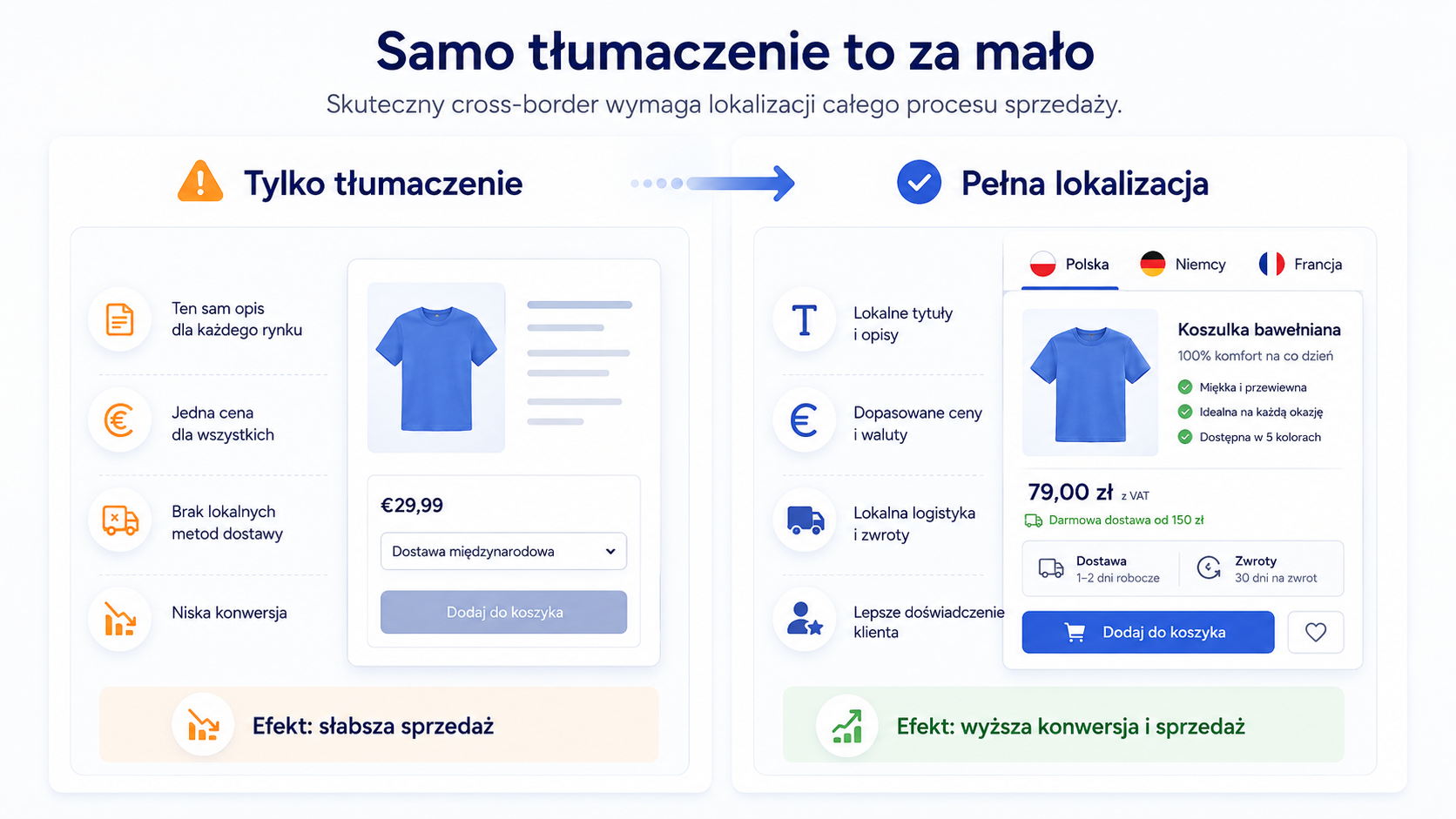
Automatic translation of the description can help, but is no substitute for localisation. An offer should sound natural to a customer from a particular country and respond to the way they search for products. Titles and descriptions are built differently on the German market, and differently on the Czech, Slovakian or Romanian market. Keywords, order of information, units of measurement, style of communication and the most important purchase arguments may differ. Therefore, an effective foreign offer should not be a copy of the Polish version. It should be prepared for a specific market.
The local customer has local expectations
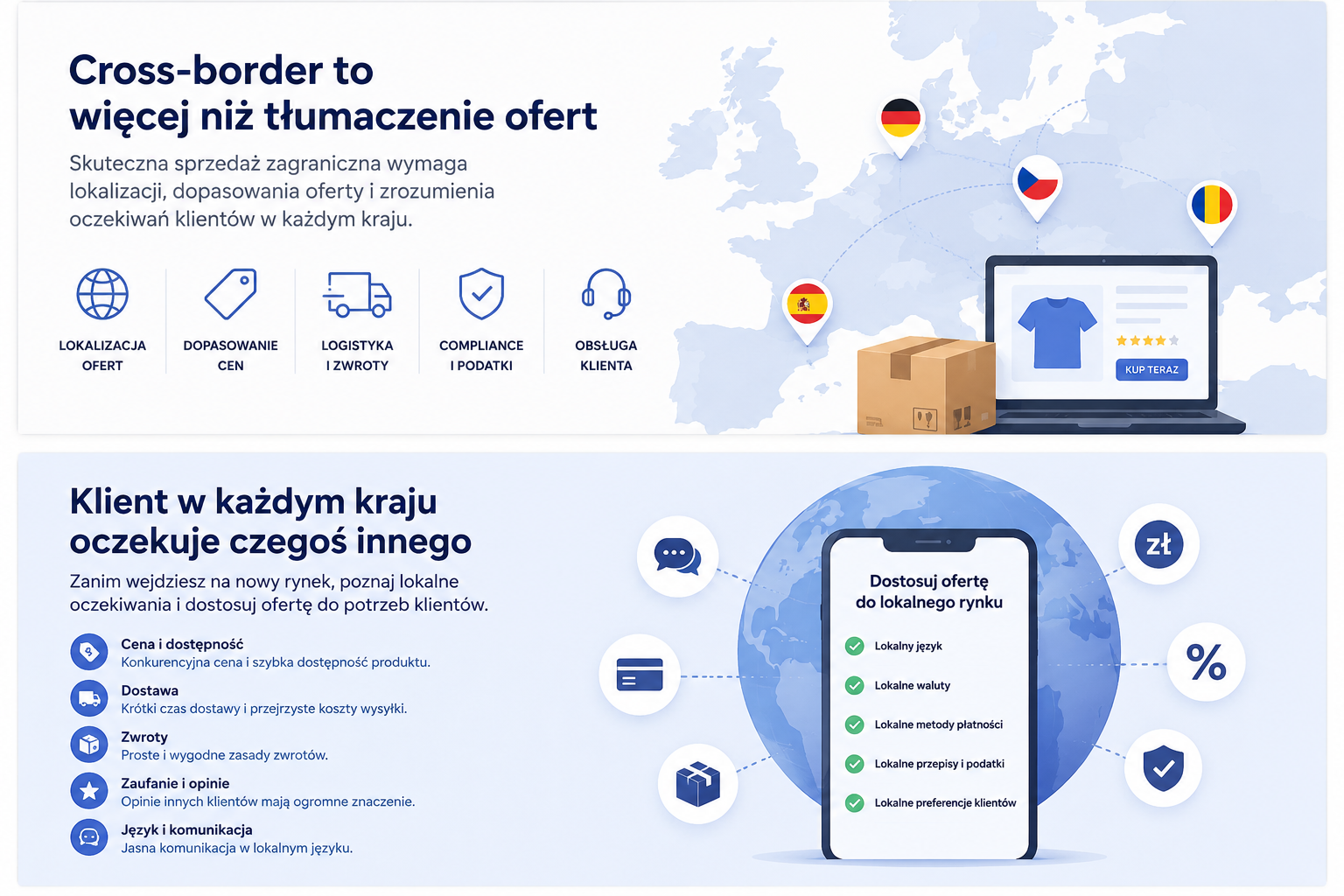
What works in Poland will not always work abroad. In one market, the customer looks more strongly at price, in another at delivery time, reviews, detailed specifications or trust in the seller. Before entering a new marketplace, it is a good idea to check what the best offers in a given category look like. Often, a competitor analysis alone will show what images, titles, descriptions and prices are standard in a given marketplace.
The price must be recalculated
One common mistake in cross-border is to carry the price from Poland and only add the marketplace commission. In practice, you also have to factor in the cost of delivery, returns, currency conversion, customer service, advertising, taxes and possible promotions. A product that has a good margin in Poland may not be very profitable abroad. Therefore, each market should have a separate price calculation.
Logistics and returns influence the purchasing decision
The foreign customer expects a simple purchase, fast delivery and clear return policies. If the delivery time is too long or the return looks complicated, even a good price may not be enough. Cross-border therefore needs to plan not only the sale, but also the entire post-purchase process: delivery, communication, returns and complaints handling.
Product data must be complete
Marketplaces increasingly require accurate product data. Missing parameters, incorrect category, incorrect EAN, poor images or incomplete description can limit the visibility of an offer or lead to its rejection. When selling abroad, there are also local requirements: language of labels, instructions, manufacturer data, certificates or compliance with the regulations of the respective market.
Summary
Cross-border in 2026 is much more than translating offers. It is about matching product, price, data, logistics and customer service to a specific market. Companies that want to sell successfully abroad should start with a strategy rather than mass copying of offers. It is better to enter a new market with a smaller, well-prepared catalogue than to put out many products that are not tailored to local expectations. A well-planned cross-border can be a strong direction for e-commerce. But only if we treat it as a separate sales process and not a simple language version of a Polish offer.
Author of the blog: Kacper Pawlak
Date of publication: 01.06.2026r.
 Polish
 English
 German
 Czech
 Hungarian
 Slovak
