


Why does the customer abandon the shopping cart? The 7 most common reasons (and how to fix them without revolutionising your business)
An abandoned shopping cart hurts because it happens closest to the money. The customer has already selected the product, added it to the basket, sometimes even entered the data... and it disappears. And now here's the important thing: it's not always a „fixable problem”. Some people treat the shopping cart like a „save for later” list or do a price comparison. Baymard research shows that a large segment of abandonment is simply browsing without being ready to buy. But if you filter out the „window shopping” itself, you are left with a group that can be recovered. And interestingly enough - in most cases you don't need to rebuild your shop from scratch. Simple adjustments are usually enough: communication, a few UX decisions, refining the basics of the checkout. For context: the average documented basket abandonment rate in e-commerce is around 70%. This means you're fighting not for cosmetics, but for real, big growth leverage. Below: The 7 reasons we see most often - and quick ways to fix them without revolution.
1. it suddenly becomes apparent that “costs will come up”
The most classic scenario: the product looks ok, the price looks ok... and it is only in the shopping cart that delivery, fees, surcharges, „packaging”, minimum order value comes into play. In Baymard's research, this is the most common reason for abandonment after subtracting „I'm just browsing”: too high additional costs (delivery/taxes/fees). Here's what you can do without redesigning your shop:
- Show the delivery cost beforehand (already on the product card or in the shopping basket before checkout).
- If the cost depends on the method - show „from £X” and give a quick choice.
- Avoid surprises like „surcharge only after entering postcode”.
The result: the customer does not feel that „someone has got him on the hook”.
2. delivery is too slow or uncertain
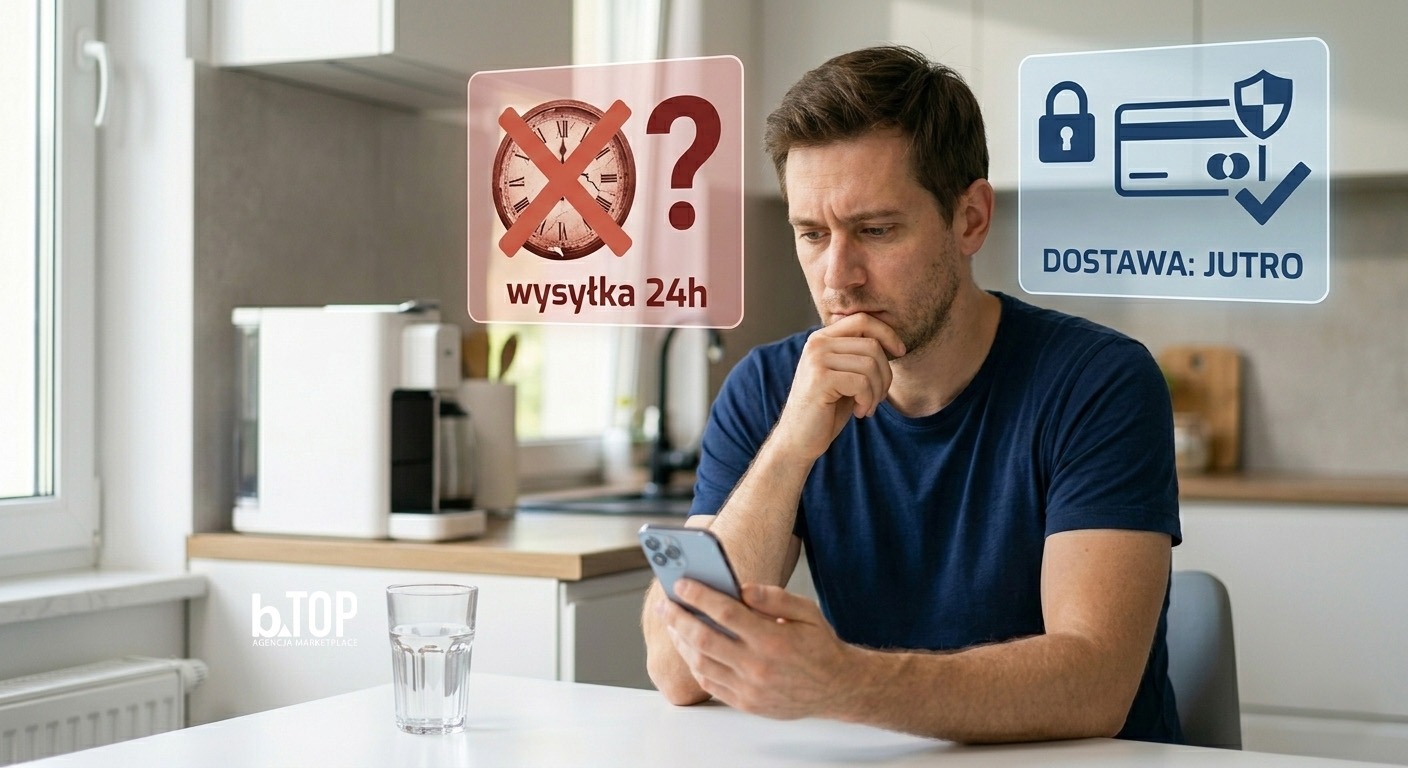
For the customer, „when will it be there?” is sometimes more important than „how much does it cost”. At Baymard, too slow delivery is one of the top reasons for abandonment. Quick fix:
- Instead of generalities („24-hour dispatch”), be specific: „dispatch today by 14:00” or „delivery tomorrow/tomorrow”.
- Show 2-3 options (e.g. parcel/courier/collection) - no 8.
- If you have seasonal delays, be honest about it before the customer moves on to payment.
The result: less „I'll come back later” and less distrust.
3. lack of trust at the payment stage
The customer may want to buy, but in their mind they have one question: „is it safe?” At Baymard, lack of confidence in providing card details is at the top of the reasons for cancellation. Without a revolution, a lot can be done:
- Add clear credibility elements in the shopping cart/checkout: company details, clear contact, brief info on returns.
- Ensure consistency: if the shop looks as if it is temporary, the customer will act with caution.
- Don't hide information - the customer should feel they don't have to extract anything.
The result: fewer last-ditch abandonments.
4. shop forces you to create an account
The customer is in quick-fix mode and here is the registration form, password, confirmations, additional steps. In Baymard's research, the requirement to create an account is one of the more common reasons for abandonment. Simple solution:
- Checkout without registration as default option (you can offer an account after purchase).
- If the account is needed (e.g. B2B) - say why and show the benefit in one sentence.
The result: less „good, not now”.
5. checkout is too long or too complicated
You don't have to have an ugly shop to lose checkout. Sometimes all it takes is too many fields, unclear form errors, no autocomplete, broken down steps that make no sense. At Baymard, an overly long/complicated checkout is a significant reason for abandonment. Quick fix:
- Delete fields that are not necessary (telephone? VAT number? mother's maiden name?).
- Leave the „easy first, details later”.
- Make sure the client sees progress and doesn't feel like it's a never-ending path.
The result: less frustration and less resignation in the process.
6. the refund policy is unclear or suspicious
The customer does not always read the regulations. But if they don't see clear information about returns in the shopping cart, a light goes on in their head: „what if something goes wrong?”. Baymard points out that an unsatisfactory returns policy is one of the reasons for abandonment. No revolution:
- Show a simple message in the shopping cart: Return in X days, simple and hassle-free (only if true).
- Add a short FAQ: how to return? who pays for the return? how long does a refund take?.
The result: less decision blockage.
7. something „doesn't work” - errors, crash, no favourite payment
Sometimes a customer wants to buy, but the page loads slowly, the form throws an error, the payment does not go through, a method they like is missing (e.g. BLIK/fast transfer/deferred payment). Here at Baymard, page errors and not enough payment methods emerge as viable reasons for abandonment, among others. Simplest steps:
- Do a checkout test on your phone (10 minutes and you'll see more than the reports).
- Ensure that payments are obvious and available as a first choice, not hidden away.
- If errors happen - log them and treat them as sales that escape the till.
The result: fewer „because it didn't go through” abandonments.

How bTOP can help if abandoned baskets are a daily occurrence for you
An abandoned shopping cart is rarely „one big problem”. Usually it's a few minor frictions along the way: unclear delivery, surprising costs, insecurity, a checkout that takes too long. The good news is that these can be corrected quickly - without tearing down the shop and without revolutionising the company. At bTOP, we help you do this in two ways: we diagnose what's really blocking the purchase, and then implement simple changes that immediately improve the customer experience. What specifically we can do for you:
- carry out a quick audit of the shopping cart and checkout (mobile and desktop) and identify the „friction points” that kill conversions,
- organise communication about delivery and returns so that the customer is not left in doubt at the last minute,
- simplify the forms and steps of purchase (without losing what is needed operationally),
- improve elements of trust: visibility of contact, rules, guarantees, clarity of process,
- Implement effective recovery of abandoned baskets (communication, scripts, remarketing - without being pushy),
- structure the customer service process so that questions do not end in silence and returns do not take away from the margin.
We'll help you with verification, laying everything out and finding the best outlets for your products. Get in touch and arrange a short chat so we can get to know your needs and offer solutions.

Author of the blog: Kacper Pawlak
Date of publication: 10.04.2026r.
 Polish
 English
 German
 Czech
 Hungarian
 Slovak
