



AI graphics on Allegro, Amazon and Kaufland – what changes will the AI Act bring?
The use of artificial intelligence to remove backgrounds from thumbnails, generate virtual product set-ups or create backgrounds for advertising banners has become commonplace in e-commerce. The use of generators such as Midjourney, DALL-E and ChatGPT has made it possible to significantly reduce the costs of visual design.
The entry into force of the EU’s Regulation (EU) 2024/1689 of the European Parliament and of the Council (the so-called AI Act) However, it introduces a specific legal framework for anyone who publishes AI-generated content in shops and on marketplaces.
- Can the AI generator add visible text to your photo?
There has been concern amongst retailers that software providers will be forced to superimpose visible text or logos onto the images generated. EU law does not require this.
Under the Regulation, AI system providers are solely responsible for the technological markings embedded in the file’s code:
Article 50(2) of Regulation (EU) 2024/1689:
„Providers of AI systems, including general-purpose AI systems that generate synthetic content in the form of audio, video, text or images, shall ensure that the output of the AI system is labelled in a machine-readable format and identifiable as having been generated or manipulated by artificial intelligence.”
This means that the files contain invisible metadata (e.g. the C2PA standard) or steganographic watermarks (e.g. Google SynthID). The downloaded image remains legible and visually clean, but the algorithms used by e-commerce platforms can easily detect its origin in the background.
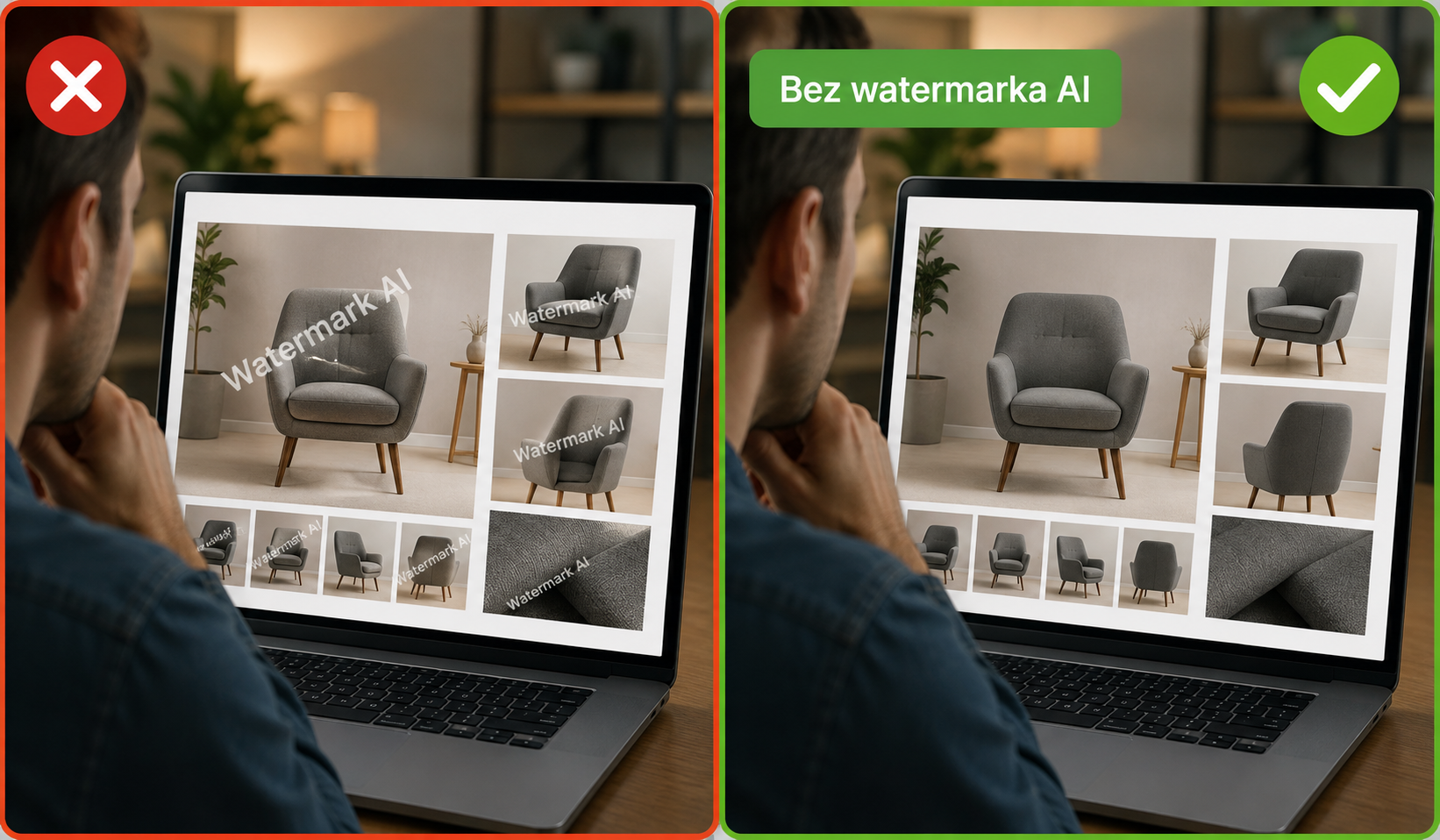
- What are the responsibilities of a seller on Namarketplace?
As an online retailer, you fulfil the following role under the law an organisation using an AI system. Whilst the tool provider is responsible for encoding the file, it is your responsibility to inform the buyer that the content has been artificially created or modified.
Article 50(4), first subparagraph, of Regulation (EU) 2024/1689:
„Entities using an AI system that generates content in the form of an image […] indicate that this content has been artificially generated or manipulated.”
As regards this, how i when this information must be provided; the provision specifies:
Article 50(5) of Regulation (EU) 2024/1689:
„The information referred to in paragraphs 1–4, is made available to the individuals concerned in a clear and distinct manner, at the latest when the content is first accessed or received.”
What does this mean in practice?
The regulation requires disclosure of information, rather than placing static text directly on the image. You can fulfil this requirement by including a clear message in the listing description (e.g. „Stylised images generated using AI”), in the ‘Parameters’ section or in the terms and conditions of sale.
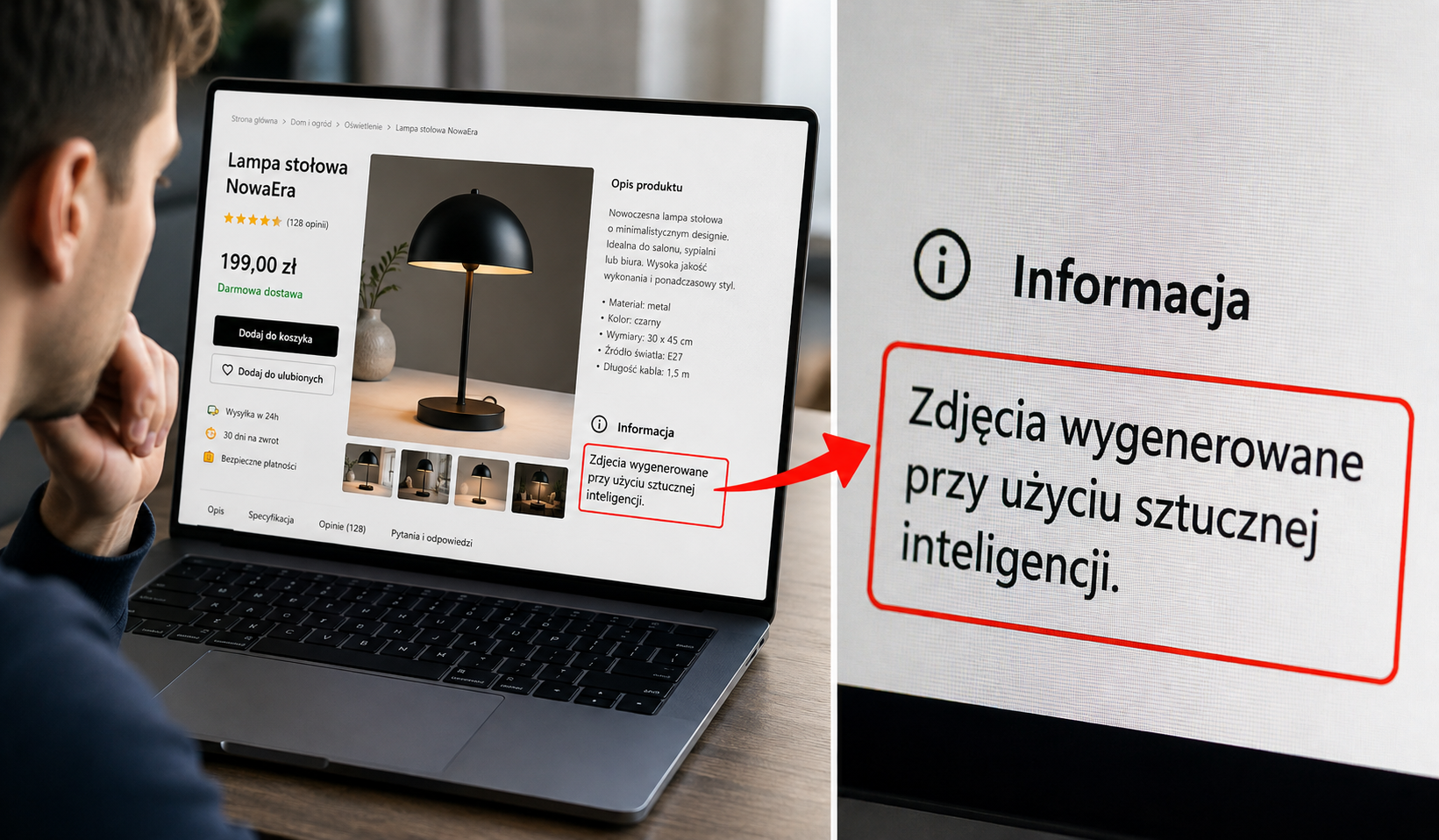
- When do you NOT have to disclose the use of AI?
The Regulation introduces a significant exemption for standard image processing and retouching. If you use AI solely as a supporting tool, you do not need to include any annotations:
Recital 134 of Regulation (EU) 2024/1689:
„This obligation should not apply to content generated or manipulated by AI which constitutes solely auxiliary elements used for editing or which do not materially alter the input data provided by the user or their meaning…”
- No obligation: Background removal (cutting out the product against a white background), sharpening, lighting correction, dust removal.
- The obligation applies: Creating a staged background from scratch, generating a virtual model, or altering key product features.
- Practical tips for online retailers
- Accuracy: Please note that labelling images with an ‘AI’ label does not exempt you from liability for misleading consumers under consumer protection legislation. The product sent to the customer must look exactly as it does in the photograph.
- Clear description: Include a short sentence in your listing template stating that the product images have been digitally created.
Important information:
This text is for information purposes only. It does not constitute legal advice or an official interpretation of the law. We accept no liability for any decisions or actions you may take on the basis of this text. Legislation is subject to change, so if in doubt, please consult a lawyer.
Blog author: Ee-commerce expert – Adrian Śmigiel (CEO)
Date of publication: 4 August 2026.
 Polish
 English
 German
 Czech
 Hungarian
 Slovak
