


Marketplace - what it is and what the future holds
We shop on them every day, although we do not always know whether a particular sales platform is a marketplace or a regular online shop. Many users, when searching Google for information about marketplaces, type in the phrase: „Marketplace - what is it?” That is why, in this short article, I would like to answer the most important question: what is a marketplace and is it the future of global e-commerce?
Is the marketplace the future?
The answer can be found by looking at the ranking of the world's largest companies. If we sort it by revenue, we see a picture that speaks for itself:
- Walmart - USD 648 billion
- Amazon - USD 574 billion
Needless to say, both of these companies are marketplaces - and are the largest companies in terms of revenue worldwide. Marketplace is an irreversible trend in global e-commerce. Amazon, although the largest shopping platform in the world, is not the most popular choice everywhere - but about that in a moment.
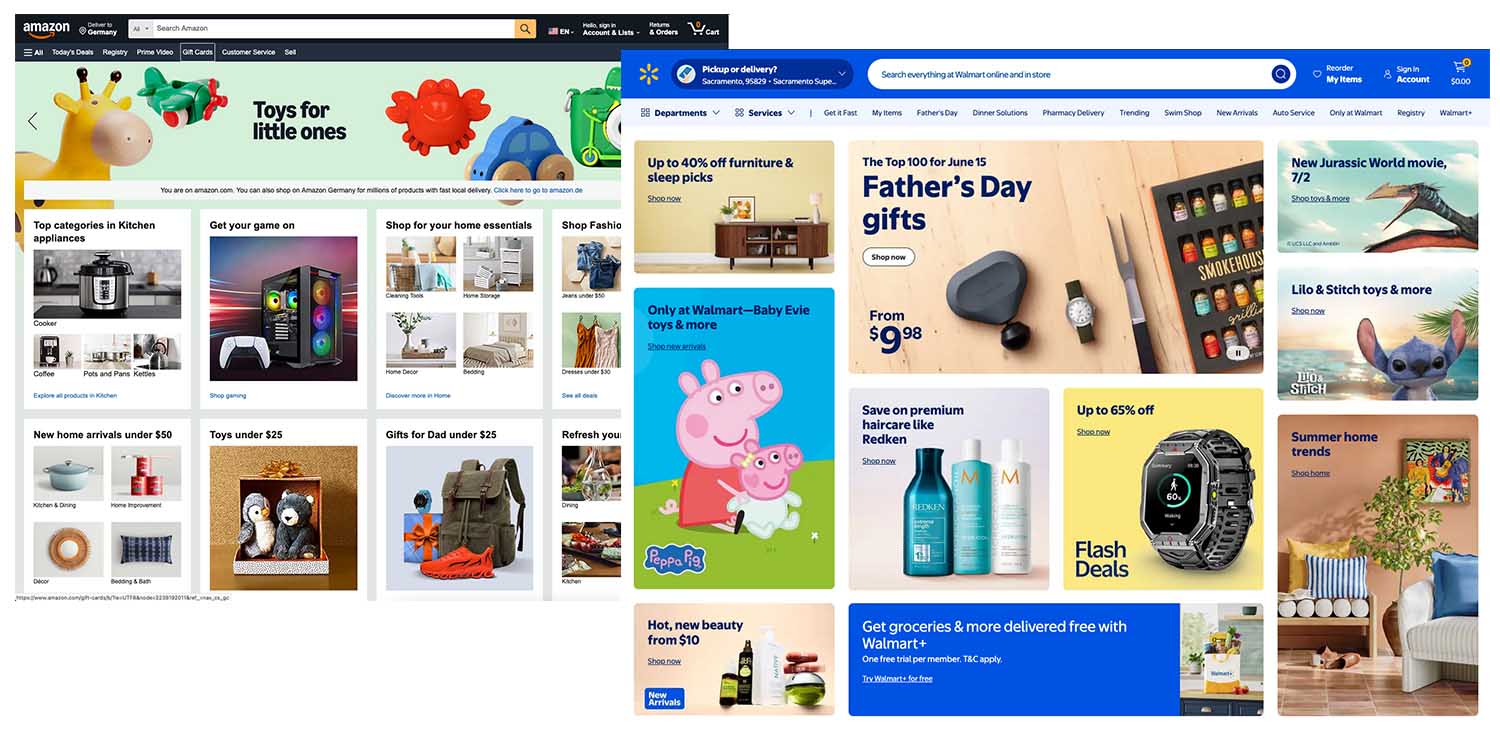
photo. global e-commerce giants. Amazon and Walmart.
What is (or what are) marketplaces?
In the simplest terms, a marketplace is a combination of all shopping malls under one virtual roof. It is a place where we can buy products from both global and local brands - at different prices, from different retailers. Importantly, it is also a source of the most reliable product reviews.
Large, well-known brands - such as Black Red White, Home&You, Media Markt, Empik or Castorama - are transforming themselves into marketplace platforms, capitalising on their reputation. More and more well-known brands are joining the marketplace catalogue. Would you ever have thought that Super-Pharm is also a marketplace?
Marketplace is a win-win-win arrangement - for the platform owner, the seller and the customer.
From the platform owner's perspective
For the creators of brands such as Home&You or Black Red White, companies with a recognisable brand and a network of stationary shops, launching a marketplace is a strategy that allows them to scale their business incredibly quickly. Large companies are well aware that marketplaces are the future. If they do not adapt to the trends, others will fill the gap very quickly.
Why else do they decide to take this step? Firstly: the market. Secondly, the ease of scaling the product range and making the offer more attractive to customers. Even the largest companies cannot indefinitely grow with their own products alone. If you are involved in online sales, you know very well that the biggest costs are human labour and warehouse space.
The Marketplace is the best way to increase revenue without having to expand logistics facilities.
From a retailer's perspective
Diversification of sales channels is an absolute must in e-commerce today. Relying solely on one platform is asking for trouble. Our golden rule is: every trading company should have at least four „legs” - i.e. four different, independent sales channels.
Marketplaces come to the rescue and can be easily implemented into any retail business. Their number and variety is enormous - it would be difficult to list them all.
However, it is important to remember that not all marketplaces are created equal. It all depends on what you are selling, what market you are operating in and what your pricing strategy is. Many platforms operate on a buy box basis - meaning that it is mainly the price that matters. For some, Amazon may not be profitable, but for others - especially those with their own brand - it could be the perfect place to scale.
It is worth looking for platforms that do not group offers by productisation - as this means less price competition. Remember: the biggest platform does not always mean the biggest profits. And the bigger the marketplace, the more fees and commissions.
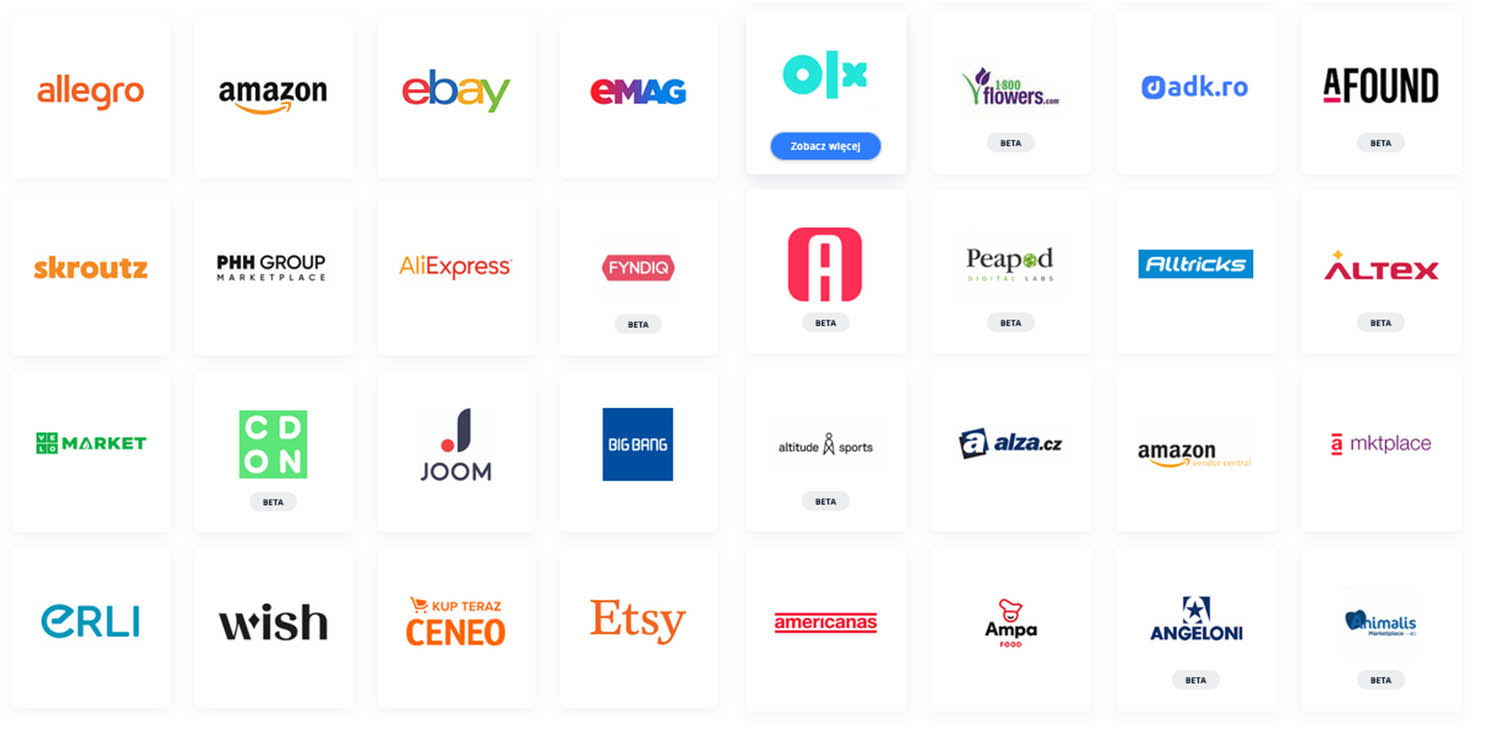
photo from Base. - applications for retailer integration into marketplace platforms
From a customer perspective
For the customer, a marketplace is a virtual shopping mall under one roof. Sales platforms have accustomed us to conveniences: free shipping, returns, buyer protection, etc. I know many online shops with top-notch service, but unfortunately - nothing beats the reach and revenue of marketplace channels.
For many brands, a presence on marketplaces is to be or not to be. I often wonder if it is possible to build customer loyalty in an online shop these days? Does it make sense if they are going to choose what is faster, simpler and safer anyway?
If a customer is used to shopping on Allegro, this is where they will look for products. For Germans, Amazon is the product finder - the first choice. You have to be where the customers are.
The world's most popular marketplaces:
Canada - 90% purchases: Amazon
USA - 82%: Amazon, the rest - Walmart
Argentina - 94%: Mercado Libre
China - 89%: Taobao
Thailand - 85%: Shopee
Australia - 62%: Amazon
Europe:
- Poland - 87%: Allegro
- Germany - 86%: Amazon
- Netherlands - 88%: Bol
- UK - 88%: Amazon
- France - 88%: Amazon
- Spain - 88%: Amazon
- Italy - 90%: Amazon
- Austria - 88%: Amazon
- Czech Republic - 74%: Alza
- Turkey - 88%: Trendyol
Author: Adrian Śmigiel
Date of publication: 09.06.2025r.
 Polish
 English
 German
 Czech
 Hungarian
 Slovak
