



TEMU changes advertising and ROAS. New rules for retailers
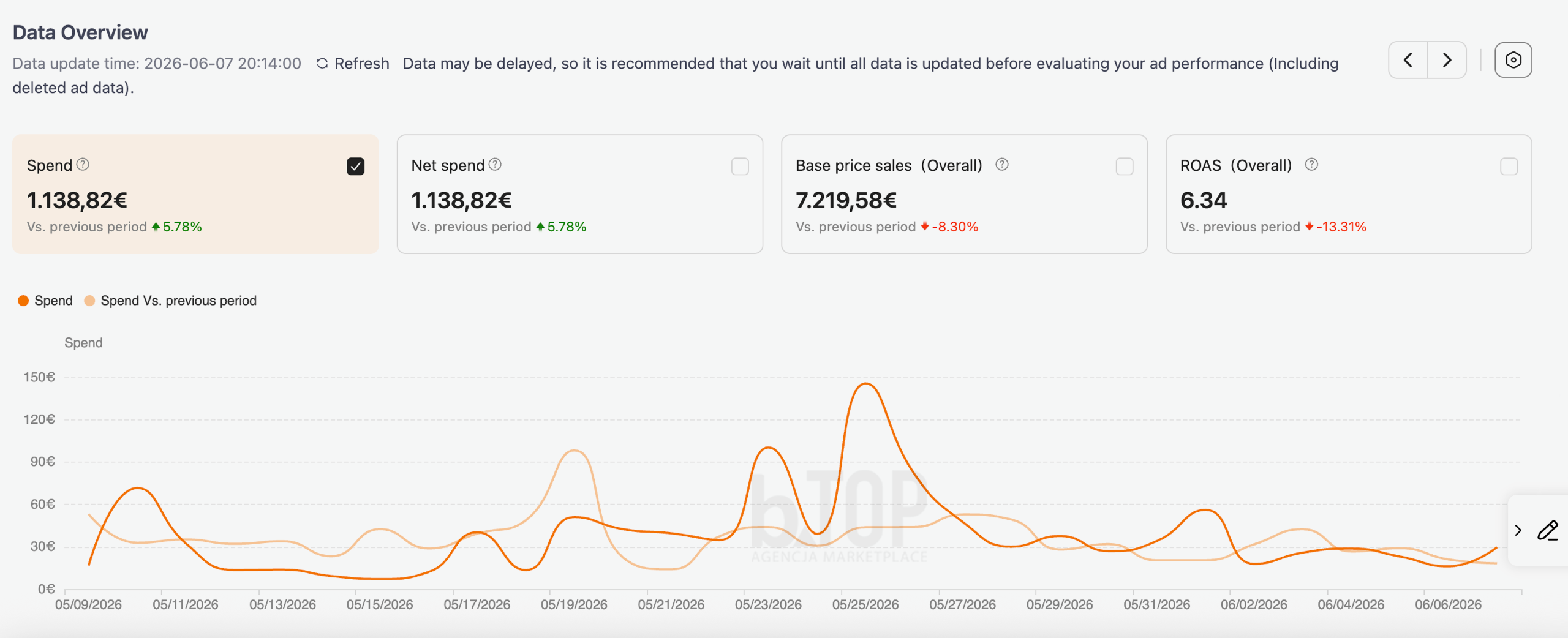
THEM introduces important change in advertisements product: the focus shifts from the evaluation of a single advertisement to a broader evaluation of the sales of the entire shop. For retailers, this means that the very ROAS remains a key indicator, but will need to be interpreted more carefully.
The most important change
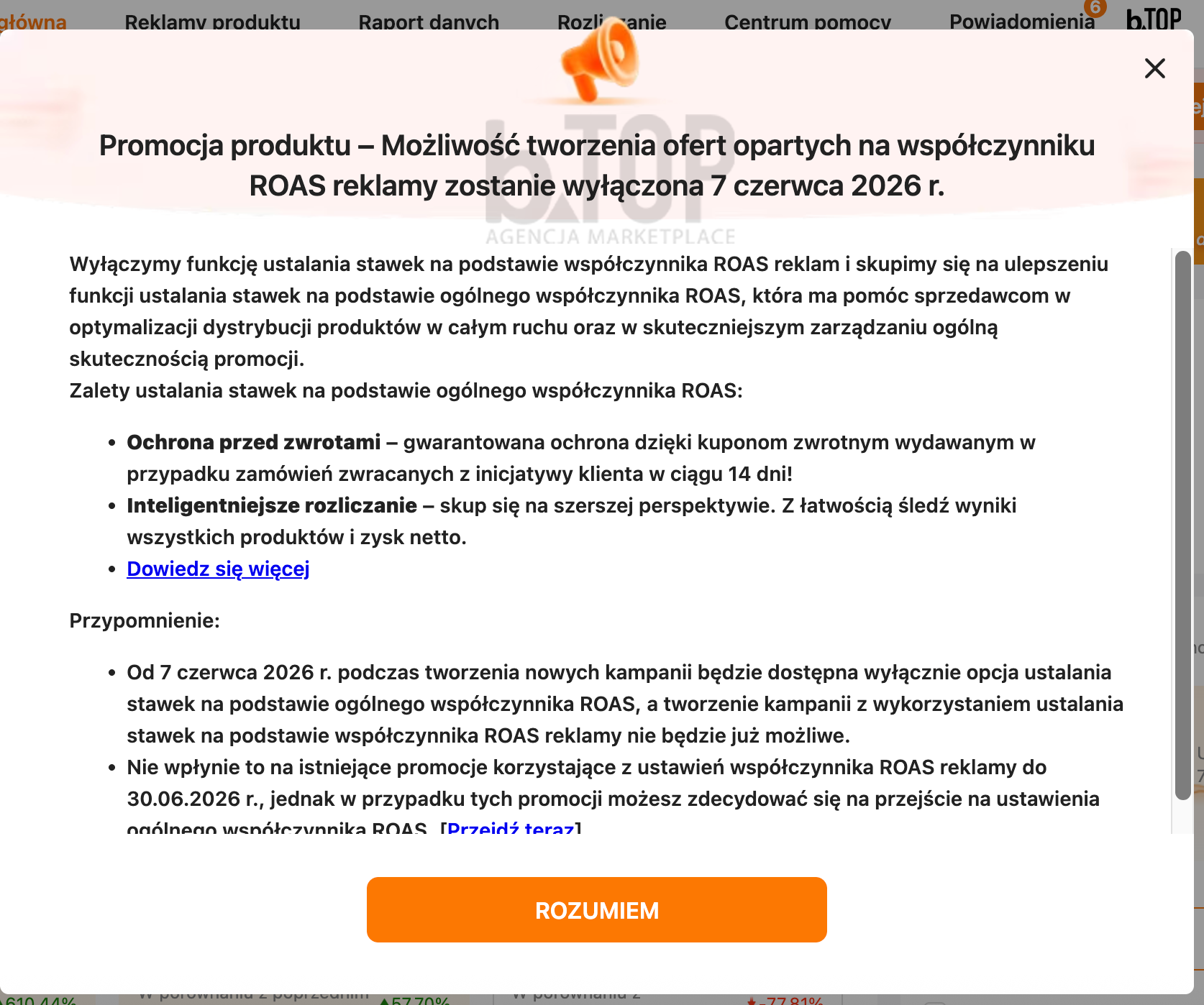
A message appears in the TEMU Help Centre stating that from 7 June 2026. the possibility of creating offers based on the ROAS of an advertisement will be deactivated. However, this does not mean that product advertising disappears or that retailers lose the opportunity to work with ROAS altogether. What changes is primarily the way the system looks at the result of the adverts and the shop's sales.
The general shift is towards a model of Overall ROAS, i.e. ROAS calculated more broadly: not only on sales directly attributed to an advertisement for a specific product, but on sales for the entire shop. In other words, the system is starting to look more strongly at the overall effect of the adverts for the shop, rather than just the simple result of a single campaign.
How did it work before?
In a simpler model, the seller could analyse the advertisement through the prism of a specific product: he would launch the promotion, set the budget, observe the cost of the ad and check the sales generated by the promoted product. If an advert spent £100 and generated £1,000 in sales at the base price, the ROAS was 10. This result was easy to attribute to a specific product and a specific advert.
Such a method was clear, but it also had limitations. A customer on a marketplace rarely moves in a perfectly linear way. He or she may click on an advertised product, enter a shop, compare several offers and ultimately buy something else. In the old approach, part of such influence may have been invisible or evaluated too narrowly.
What is Overall ROAS?
Overall ROAS implies a broader view of effectiveness of advertising. Advertising is not only considered as a sales tool for one promoted product, but as an element that can influence the sales of the entire shop. If an advertisement brings a customer into a shop and the customer buys another product, such an effect can be important in assessing the outcome.
This approach may better reflect customer behaviour on the marketplace. Shoppers often move between products, comparing variants, adding other items to their basket or choosing a product with a better price, images or availability. In such an environment, advertising one product can realistically work to sell a wider catalogue.

CIs it still possible to set ROAS for specific products?
Yes. With information from THEM results, that The target ROAS continues to function as setting at advertising product.
However, this should not be understood as full return to the old model, in which the effectiveness of advertising was assessed solely by the sales generated directly by the promoted product. Target ROAS per product Rather, it acts as a signal to the advertising system: it shows how aggressively a particular advertisement can bid and what level of return the seller expects.
TEMU explains that a lower target ROAS means in practice a higher rate. This can help advertising reach more people and get more sales at the base price. A higher target ROAS means more careful bidding, but maybe limit the range and number of potential orders.
In practice, the retailer can still influence the intensity of promotion of a specific product, but the system no longer looks at that product in complete isolation from the rest of the shop. With the Overall ROAS model enabled, the algorithm takes into account the broader effect of advertising on the shop's sales. Advertising for a specific product can therefore support not only the sales of that one product, but also traffic and orders across the entire shop.
This is an important difference: ROAS per product still helps to control the level of promotion of a particular product, but the final assessment of effectiveness can be more holistic. Therefore, after the changes it is useful to analyse two levels of data: the result of specific product advertisements and the result of the shop as a whole.
How can the system interpret the target ROAS?
The target ROAS is information for the system about the acceptable ratio of sales to advertising costs. If a retailer sets lower target ROAS, gives the system more room to bid and acquire traffic. The ad may then display more frequently, but the cost of acquiring sales may be higher.
If the seller sets higher target ROAS, the system should operate more cautiously. This may protect margins, but at the same time limit coverage. TEMU also points out that for new products or products without sufficient data, estimates may be based on the product category. This means that the system does not always have the full history of a particular SKU and can use comparative data.
|
Setting |
What it means for the system |
Risks for the seller |
|
Lower target ROAS |
Higher stakes and a greater chance of coverage and sales. |
Greater cost of advertising and risk of margin erosion. |
|
Higher target ROAS |
More careful bidding and more control over the return. |
Less reach, fewer impressions and fewer potential orders. |
|
New product or little data |
The system can be based on category data rather than product history. |
Initial results may be less predictable. |
What does this mean for retailers?
The biggest change is in the interpretation of the data. A good ROAS score at shop level does not necessarily mean that every promoted product is making money. It can mean that advertising is generating traffic and sales are appearing in other parts of the catalogue. This can be very beneficial for well-crafted shops, but risky for retailers who only look at one overall indicator.
If a shop has a broad catalogue, complementary products, good prices and stable margins, the Overall ROAS model can better show the real impact of advertising. Advertising for one product can trigger sales of other products that the customer already finds upon entering the shop.
However, if a shop has widely varying margins, a poor pricing structure or products with varying profitability, the overall ROAS may give overly optimistic picture. Sales may be growing, but profit is not necessarily growing in including alone pace.
Changes in attribution and accounting for returns
One of the most important changes in the new TEMU advertising model is the extending the way in which the effects of promotion are counted. The system no longer looks solely at simple sales attributed directly to a single advert. Wider traffic is to be optimised during a product promotion: search, promotions, recommendation scenarios and other places where the user may come into contact with the product.
It is also important to 30-day attribution window. This means that if a user sees an advertisement for a product, clicks on it and then places an order within the following 30 days, the sales revenue declared for that product can be included in the promotional result.
For example: if a user sees an advert for a product on 1 January 2026, clicks on it and places an order before the end of the 30-day attribution window, sales of that product from the order will be attributed to the promotional effect.
This is an important change because the result of the ad can include a longer purchase path. The customer does not have to buy the product immediately after clicking. He can come back later, compare the offer, see the product again in the recommendations or search for it himself. If this falls within the 30-day window, the sale can still be included.
A second important area is extended eligibility criteria for reimbursement. TEMU distinguishes between several types of returns and in certain situations provides for a benefit to the seller related to promotional costs.
First category are orders with immediate return approved by the platform. These are situations where the buyer submits a return within 1 hour of successful payment and the seller has not yet shipped the goods. In this case, once the return is approved by the platform, the promotional spend is to be reduced as a benefit to the seller.
Example: the user places an order on 1 January 2026 at 14:00 and makes a return within 1 hour. If the order meets the conditions and is approved by the platform, the promotional fee will be deducted from the next order.
Second category are other refund orders approved by the platform. This includes, but is not limited to, orders returned within 14 days after successful payment or order confirmation for user-related reasons. The platform may also assess other return cases, taking into account factors such as the reason for the return and the timing of the return.
For eligible refund orders that pass the review, the retailer can receive a certain amount of the refund voucher as a benefit. This is therefore not an automatic cancellation of the entire order history in the statistics, but a mechanism to compensate for certain promotional costs if the refund meets the platform conditions.
For example: if the user makes a return before 14:00 on 15 January and the order with the return is approved, the platform can issue the specified amount of the return voucher as a benefit to the retailer, under the condition that the item has not yet been dispatched and the return meets the criteria.
For retailers, this means two things. Firstly, the effectiveness of the promotion will be counted in a broader, 30-day context, and not just when the ad is clicked on. Secondly, part of the promotional costs related to reimbursements may be adjusted, but only if the return meets the conditions set by TEMU and is approved by the platform.
Key conclusion: in the new model, it is not only ROAS itself that needs to be analysed, but also the attribution window, return time, shipping status and whether an order qualifies for a promotional cost adjustment or a return coupon.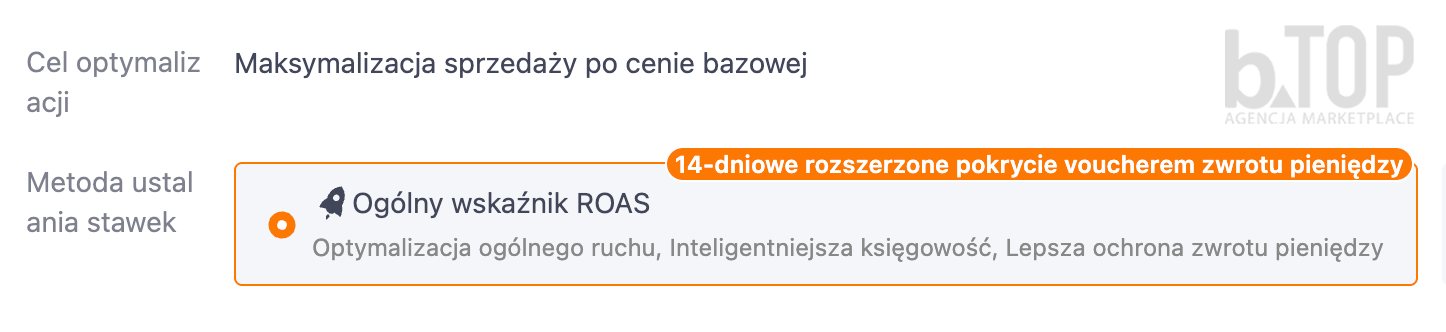
Will sales at TEMU be more expensive?
It cannot be said that selling on TEMU will automatically become more expensive for every seller. It is more accurate to say that selling on TEMU will required more accurate calculation of advertising costs and margins.
The change in the ROAS model may increase the importance of automation and optimisation at a shop-wide level. For some retailers this will be an advantage, as the system can exploit the potential of the catalogue more widely. For others, it will be a risk, as it will be easier to confuse sales growth with real profitability growth.
What is worth checking before working on a new model?
Summary
TEMU is moving product advertising towards an Overall ROAS model. This means that the effectiveness of the ads is to be assessed more broadly, by the impact on sales of the entire shop, rather than solely by the base sales attributed to a single ad. At the same time, the target ROAS next to the product still remains an important setting that influences the bidding method and the intensity of the promotion.
For retailers, the most important thing is to not to treat ROAS as a simple, margin-independent indicator. After the changes, you have to look at advertising more operationally: product by product, campaign by campaign and at the same time through the result of the whole shop.
Author of the blog: Adrian Smigiel
Date of publication: 08.06.2026r.
 Polish
 English
 German
 Czech
 Hungarian
 Slovak
